SEO-led architecture for a platform with millions of pages
Building ukpropertylooker.com from scratch: domain selection, content pillars, programmatic page generation, and the tech SEO decisions behind 141,000 clicks in five months.
Client: UK Property Looker
Site: ukpropertylooker.com
Scope: SEO strategy, information architecture, domain selection, branding, tech SEO advisory
The starting point
UK Property Looker began as a concept for a residential property search platform covering the UK. The founder was weighing 2 options: acquire an existing property business or domain, or build from scratch.
The build-from-scratch route won on 4 counts. Lower upfront cost. Full control over the technology stack. Architecture designed for performance and UX from the start. And faster time to market without negotiating a merger.
Starting from zero meant every decision could be made with search visibility in mind. Domain, brand, site architecture, tech stack. It's uncommon to have that level of control over an SEO foundation.
Domain and brand as search decisions
The domain ukpropertylooker.com was chosen for search relevance. It carries a UK geo signal, category relevance (property), and intent alignment (looker implies browsing and searching). Within months of launch, branded queries like "property looker" and "uk property looker" reached position 1 in Google.
The initial branding and site design were collaborative. I worked alongside a fullstack developer, vibe coding the first design iteration myself. Visual and structural decisions were shaped by search intent and information architecture. The identity needed to feel credible for a property platform while staying lean enough to iterate quickly.

Information architecture at scale
A property search platform covering the UK can run to millions of pages. Individual property listings, area pages, postcode pages, local data. The information architecture had to account for that scale from the start.
The content structure was organised around 4 SEO-led pillars, each serving a dual purpose: user utility and crawl efficiency.
Calculator tools
Interactive utilities like stamp duty calculators and mortgage estimators. These serve informational intent, attract links, and give users a reason to return.
URL structures
Clean, hierarchical paths that communicate page relationships to both users and search engines. Location, property type, and individual listings each sit at the right depth. At millions of pages, URL structure is one of the clearest signals a site sends to crawlers about content hierarchy.
Menu navigation
The primary navigation surfaces high-value category and location pages. At this scale, navigation architecture directly affects crawl distribution and internal link equity.
Blog pillars
Topical authority clusters that support the core programmatic pages. Posts on property topics, local area guides, and buying and selling advice feed relevance signals back to the transactional pages they link to.

At millions of pages, the focus shifts from optimising individual URLs to optimising the system that generates and connects them.
Tech SEO for programmatic content
The platform is built on Next.js, which offers native support for many SEO essentials but still needs deliberate configuration at this scale.
Metadata
Dynamic title tags, meta descriptions, and Open Graph data generated programmatically per page template. Each property listing, area page, and postcode page produces unique metadata without manual input.
Sitemaps
XML sitemaps segmented by content type and region to stay within size limits and signal priority to crawlers. At millions of URLs, a single sitemap file isn't viable. Segmentation also makes it easier to monitor indexation rates by section.
Robots.txt and crawl management
Controlling crawl access to parameter-driven pages, filtered views, and thin content that shouldn't consume crawl budget. Programmatic sites tend to generate a long tail of low-value URLs, so crawl budget management matters early.
Structured data / Schema markup
Structured data for property listings, local business information, and breadcrumb navigation. This feeds into rich results and helps search engines parse page relationships at scale.
Analytics and conversion tracking
GA4 configured alongside advanced Google Ads conversion tracking from launch. Clean data from the start means the advertising account learns from accurate signals, which tends to improve bid optimisation and campaign quality scoring over time.
Early results
141,000 clicks and 2.15 million impressions across the site's first 5 months (November 2025 to April 2026), with an average position of 7.6 and a CTR of 6.5%.
Growth was steady through December and January, then the curve steepened noticeably from mid-March 2026. Branded queries like "property looker" and "uk property looker" reached position 1 within months of launch. Individual property and location queries are ranking at positions 2 to 3 with click-through rates above 45%, which suggests the programmatic pages are matching search intent well.
This is early-stage data. The site is still building domain authority and the growth trajectory, while steep, isn't yet mature. Seasonality in the property market also likely contributed to the March uptick. Spring tends to see increased search demand for property-related queries.
Paid search
The conversion tracking setup also meant Google Ads campaigns could run from a clean data foundation. Over the same period, paid search generated 349,640 impressions, 33,155 clicks, and 2,654 conversions. That's roughly an 8% conversion rate from click, which suggests the landing pages and tracking are doing their job.

Daily conversions ramped from near zero to a steady 40 to 60 per day, with the upward trajectory tracking alongside organic growth. Having organic and paid share the same underlying architecture and tracking setup tends to make both channels more efficient.
Update May 2026: Bing AI search citations
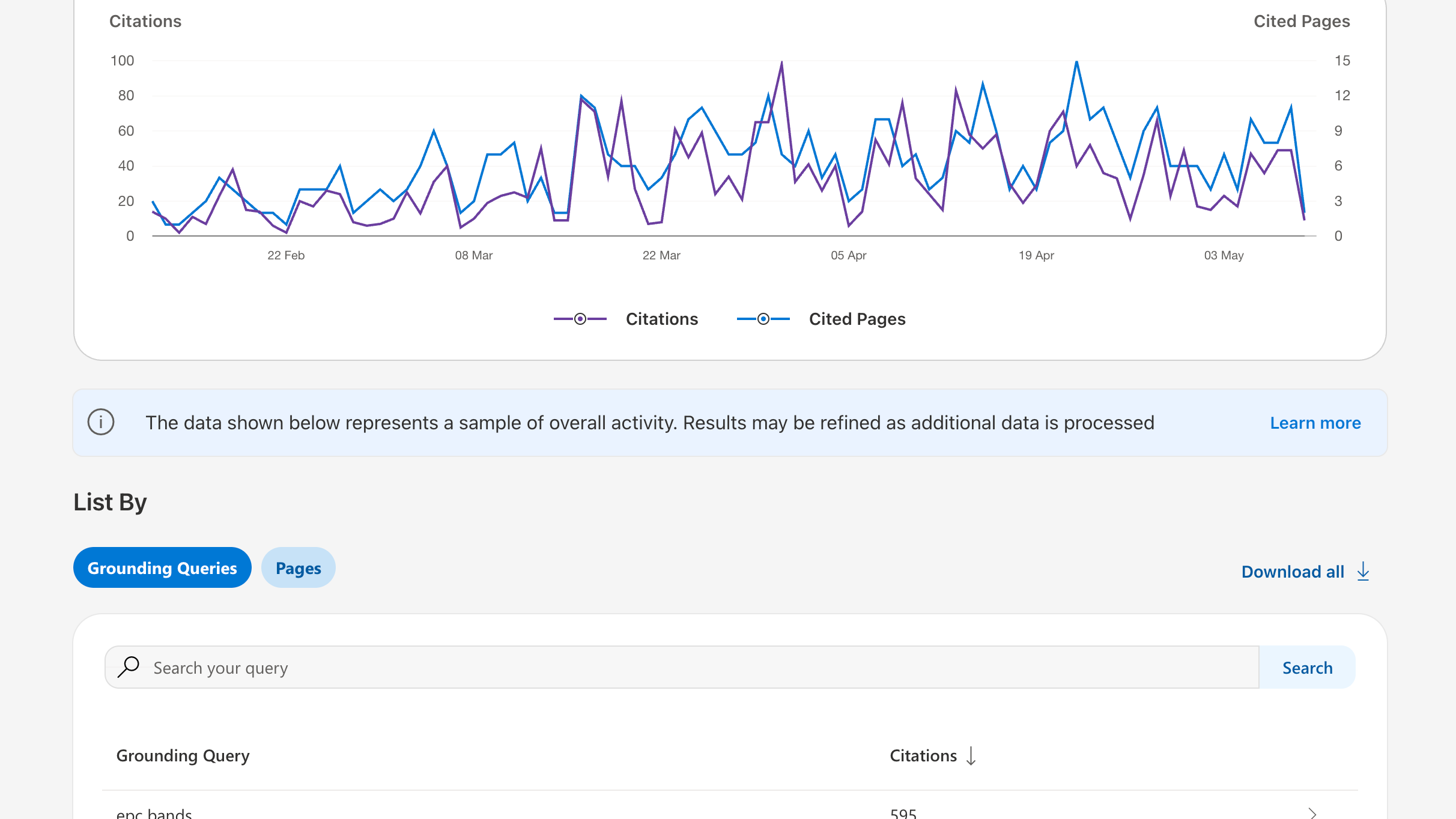
In the 87 days from 12 February to 9 May 2026, ukpropertylooker.com pages were cited 2,781 times in Bing AI-generated answers, averaging 32 citations per day with 6.2 unique pages cited each day. Daily citations more than doubled between the first and last 28 days of that window, moving from 16 to 39 per day.

The Bing AI Performance Report shows which queries are grounding those citations. Two content clusters do most of the work. EPC content (epc bands, epc scale, epc band, epc g) accounts for roughly 794 of the reported citations. RICS survey content (rics surveys explained, residential survey, level 1 survey, survey levels) adds another 223. Mortgage explainer content and home move checklists make up the next layer.
These are blog-pillar pages. They sit in the topical-authority clusters built to support the programmatic transactional pages. The IA decision to invest in pillar content alongside the property-listing system shows up here directly: the explainer pages are the ones AI assistants are drawing from when answering UK-buyer questions.
Citations are concentrating on a small number of high-utility explainer pages, which is what you'd expect when an architecture is working as designed. The growth curve also tracks the same mid-March inflection point that organic clicks showed in the original results, which suggests the AI surface and the traditional search index are moving together rather than independently.

ChatGPT tracked visits onsite totalled over 400 visits to date with decent avg engagement time per active user at 24 secs - 1 m 3 secs.
Update October 2026: Google AI features
Search Console's Generative AI report, available from June 2026, counts how often a site's links are shown in AI Overviews and AI Mode. For ukpropertylooker.com it recorded 400,000+ appearances between 18 May and 5 October 2026, about 2,800 a day. Impressions ramped from about 100 a day in mid-May to a July peak. After a quieter August and early September, they stepped up from 25 September to between 9,000 and 12,000 a day.
90% of those appearances came from UK searches, split roughly evenly between mobile and desktop.
Google and Bing are drawing on different parts of the site. Bing's citations in the spring concentrated on the EPC and RICS survey explainer pages. Google's AI features surface the programmatic pages: individual property addresses, postcode pages, area pages and the homepage. The top 1,000 pages carry under 4% of the Google total, so most of it sits across tens of thousands of property pages each shown a few times.
Google reports impressions only for this surface, so this is a visibility figure rather than visits. The data also sits inside the overall Search Console totals rather than on top of them.
Scope and involvement
This project started with strategic advisory: the build-versus-acquire decision, domain selection, information architecture, content pillar strategy, and tech SEO requirements. From there, the work moved to hands-on collaboration alongside the development team on an ad hoc basis, then shifted to lighter advisory as the platform matured.
The UK Property Looker team owns day-to-day development and content. The consulting work covered the strategy and architecture layer the platform was built on: domain and brand decisions, information architecture, content pillar design, and the tech SEO standards for the build team to implement. This kind of involvement is most useful when it starts at day zero, before the stack and URL structure are set, and when the build team is fluent with AI tooling. The result is content architecture that performs in both organic and AI search, as the AI citation data above shows.


