What the new Bing report reveals about AI search visibility (and why it matches the social shift)
Microsoft launched the Bing AI Performance Report in February 2026. It's the first time most publishers can see whether AI tools are citing their content. What the data shows reinforces what social platforms already told us about how discovery works now.
Introduction
In February, Microsoft launched a report inside Bing Webmaster Tools that shows publishers which prompts cited their content in Copilot answers. For most brands, it's the first time this data has been visible at all.
For years, AI search visibility was guesswork. You could prompt an AI tool yourself and see whether your site came up, or read industry coverage about how generative search was reshaping discovery. The Bing AI Performance Report is the first first-party view at scale of whether your content is cited, and for which prompts.
This piece picks up where Keyword stuffing on social media is following a similar arc as early SEO left off. That piece argued that social platforms have moved to semantic content understanding, the way search engines did a decade earlier. AI search has been working semantically from day one. That's how large language models read content. What's new is measurement. The Bing report puts AI citation visibility on a dashboard.
What the report shows
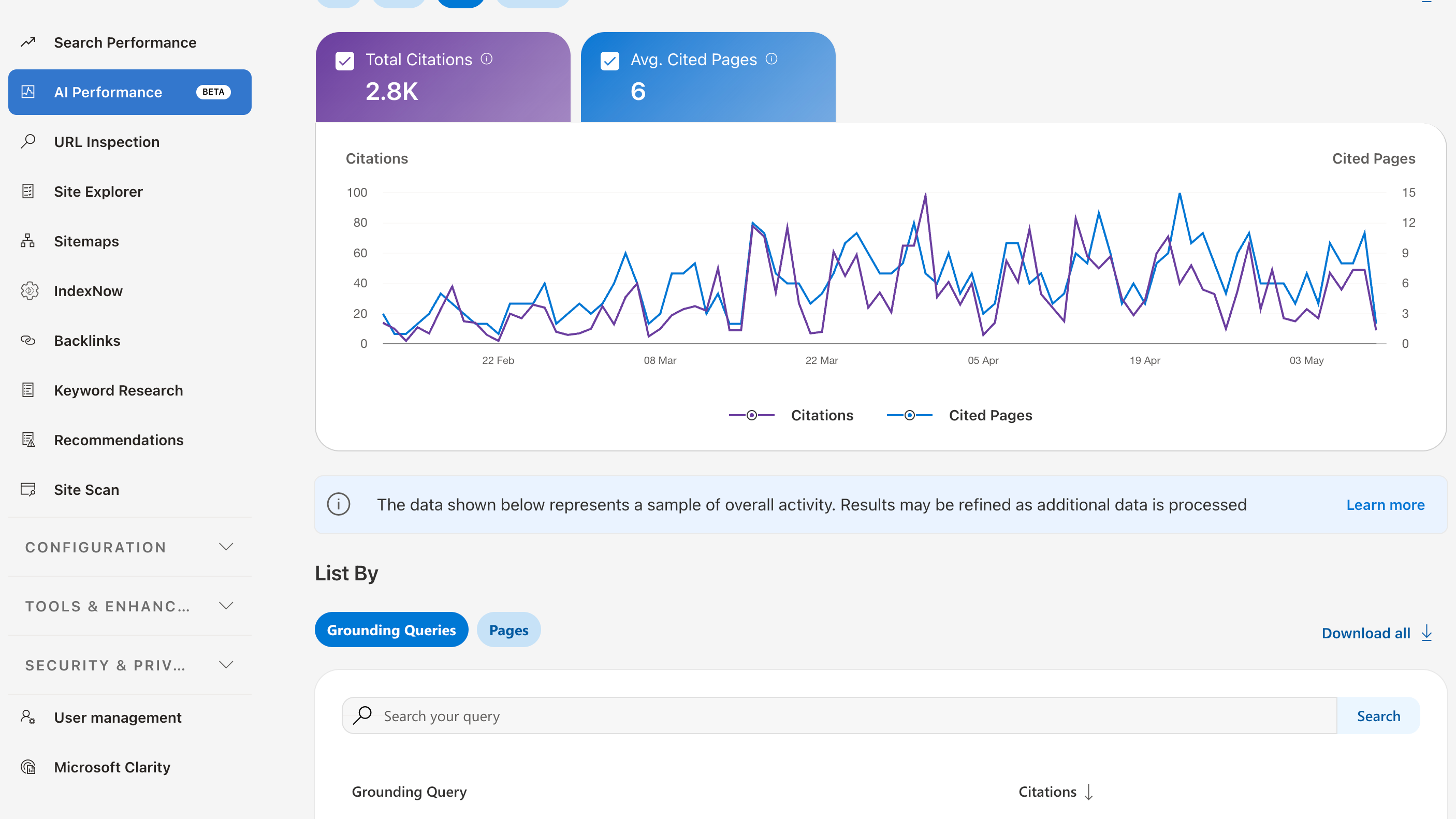
The AI Performance Report covers Microsoft Copilot, AI-generated summaries in Bing search, and select partner integrations. The dashboard displays:
- Total citations: citations from your site that appear as sources in AI-generated answers, for the selected date range.
- Avg. cited pages: the average number of unique pages cited per day during the selected date range.
- Grounding queries: the retrieval phrases the LLM uses to find your content. These are generated from the user's prompt via query fan-out, not the user's original wording.
- Page-level citation activity: counts of citations per URL
- Visibility trends over time: a timeline view of citation patterns
Of these, grounding queries is the most useful field for content strategy. It's the rephrased query the AI generates internally to find a source, a direct signal of how the system reads your content's topic.
Microsoft added a mapping between grounding queries and pages in March 2026. You can take one grounding query and see every page of yours cited for it, or take one page and see which grounding queries are driving its citations. The second direction is the more revealing one. A page earning citations for queries you didn't write it for is telling you what the system thinks the page is about, which is often not what you set out to say.
Why this matters now
AI search hasn't changed direction. Large language models have been reading content semantically since they were first deployed in search. They process page content, structure, and entity signals to determine relevance. The behaviour has been consistent.
What changed is visibility into the behaviour. Publishers can now answer three questions:
- Is our content being cited in AI answers, and how often?
- Which pages are AI tools pulling from?
- What language does the AI use to find us?
The Bing report converts that guesswork into a dashboard. The data isn't yet available via API, and the report is in public preview, so coverage will expand through 2026.
The convergence with social platforms
The April Addy piece showed that social platforms have moved to direct content understanding. Instagram reads images and audio. TikTok scans video frames and transcribes speech. Captions and on-screen text are now ranking inputs while hashtags have been demoted. That was the same pattern that defined search engines a decade ago, compressed into a couple of years.
Reading the Bing data alongside the social shift makes the convergence point sharp. Every discovery surface now reads content directly. The signals differ across platforms (caption transcripts on TikTok, schema and structured data for AI search, in-page heading hierarchy for traditional Google) but the underlying model lines up. Find the credible source for the topic. Surface it.
The work to be cited by AI looks substantially like the work to rank in Google, which looks substantially like the work to be discovered on TikTok. Substantive content on a topic the publisher knows well. Clear structure that systems can read, with credibility signals from beyond the page itself.
What to watch in the citation data
Three questions to ask of the citation report when looking at it for the first time:
- Are the grounding queries the language your customers use, or a generic version of it? If the AI is finding you through "what is X" queries when your customers ask "best X for Y", there's a content gap to close.
- Do the cited pages match the ones you'd want cited? Thin overview pages getting cited more than deep expert pages points to a structure problem to fix.
- Is visibility trending up or down across new prompts? Citation count over time is more useful than a single snapshot.
Bing samples grounding queries rather than showing all of them, and refines that data as more is processed. A single week's movement can be sampling noise rather than a real change. The signal to trust is direction over a longer window, read against a stable set of queries that matter to the business. A week-on-week jump on its own usually isn't a result.
What's still missing
The report shows when AI tools cite your pages. Whether anyone then visits your site is a separate question, and harder to measure. AI answers resolve a lot of user intent on-page, so click-throughs from citations are less common than from traditional search results.
Google Search Console has had similar limitations with AI Overviews and AI Mode visibility. The reports show coverage without full click attribution. SparkToro and Datos data showed that AI Overviews reduce organic click-through rate by approximately 70%.
The report covers your own citations and says nothing about anyone else's. You can't see how often a competitor is cited for the same grounding queries, or where visibility in your category is concentrating. You build that comparison from the first-party data you already have. Take the grounding queries Bing shows you and hold them against the queries you know matter in your market. Read that next to your own search and content performance. It's slower than a single share-of-voice score, and it stays within what first-party data can support today.
For brands measuring marketing impact, this means AI citation tracking belongs alongside other top-of-funnel discovery metrics, not bottom-of-funnel attribution. Brand mention frequency, content recall, and citation count are leading indicators. Direct revenue attribution from AI citations is still difficult.
Sits alongside SEO. Now also alongside social.
The work hasn't changed. It's mostly the work that was already on the list. Page Experience, Helpful Content, accessibility, structured data, off-site authority.
What's new is that for the first time across two surfaces in the same year (AI search via Bing, social via Instagram and TikTok's new ranking signals), the measurement is catching up to the discipline.
For brands wondering where to spend on visibility in 2026, there is one audit. It covers the surfaces customers now use, and the fundamentals carry across.
Closing notes
The Bing data confirms in AI answers what the social shift already showed. Substantive content travels.
Sources
- Bing AI Performance Report announcement, Microsoft Bing Blog, February 2026
- AI Performance dashboard update, including grounding query to page mapping, Microsoft Advertising blog, March 2026
- Elevating the role of grounding on the AI web, Microsoft Bing Blog, February 2026
- Keyword stuffing on social media is following a similar arc as early SEO, Addy LinkedIn, April 2026
- Experiential Search for more helpful digital experiences, HGDR Consulting blog
- Instagram algorithms and ranking signals, Instagram for Creators
- TikTok recommendation system and content understanding, TikTok Transparency
- Google search +21.64% in 2024 and AI Overviews CTR impact, SparkToro/Datos, January 2025


