Henrietta & Co: a Shopify rebrand and domain migration
How a jewellery retailer changed its name, domain and Shopify store in one move, and how every old page address reached the new site on switchover day.
In September 2026 Henrietta & Co changed its name, its web address and its Shopify store at the same time. This case study covers how the search-traffic risk was measured before anything moved, what has to move in a Shopify migration, how the new store was checked before launch, and how 600+ old page addresses all reached the new domain on switchover morning.
Henrietta & Co sells antique and vintage engagement rings from a showroom in Bath. I ran the SEO and migration work over 8 weeks, ending with the switchover to the new domain. We had worked together earlier in the year on the Shopify relaunch, which is why the store was in good technical shape to begin with.
In brief
- 3 changes at once: new brand name, new domain, new Shopify store.
- 600+ products, 4,500+ images and videos, 70+ blog posts and the full customer and order history moved, with every count checked against the new store.
- 600+ old addresses tested on switchover morning. All reached a live page on the new domain by permanent redirect, all but 1 in a single step.
- Google's Change of Address validated the same day. Pages carrying the old name in their title, description or heading went from 600+ to 0.
Why a rebrand puts search traffic at risk
When a business changes its name, people who search for the old name stop finding it. That sounds obvious, but the size of the problem is not, and it is worth measuring before anything moves.
Google Search Console, the free tool that shows which searches bring people to a site, showed that searches for the old name made up a small share of the times the site appeared in Google's organic results but a much larger share of the clicks. People searching a brand by name click through far more often than people searching for a type of product. Almost all of those brand clicks landed on the home page. Product searches such as "art deco solitaire" landed on collection and product pages and did not depend on the name at all.
The risk split in 2. Traffic from the old name would fall for a while whatever we did. Traffic from product searches would hold, but only if every page, redirect and piece of structured data made it across intact.
Before anything moved, I gave the client a forecast for the first year: a dip in organic visits, mostly in the first 3 to 6 months, and 3 ways to keep it at the low end.
- Keep the old domain registered and connected to the store for at least 12 months. Every visitor and every ranking signal from the old name travels through the redirect, and that stops the day the domain lapses. It is the highest-value action on the list and it costs a domain renewal.
- Wait for the first 4-week results before asking anyone to update their links. The old name was the most common wording other sites used when linking to the store. Those links hold the old-name rankings during the transition, so changing them early speeds up the loss.
- Tell customers, suppliers and press about the new name. How quickly people learn it is the main thing separating the best case from the worst, and the one lever entirely in the client's hands.
Migrating a Shopify store: what has to move
The content moved from the old Shopify store to the new one first: 600+ products with 4,500+ images and videos, 70+ blog posts and 20+ pages, plus collections, menus, existing redirects and the media library.
I checked every count against a fresh export from the new store rather than trusting the import reports. That mattered. The first import had reported success while most blog posts still carried the old name in their text. They were rewritten the same evening.
Finishing the rebrand meant editing 600+ records. Most were the product vendor field, which the theme uses as the brand name in structured data. Structured data is a block of code on each page that tells Google what the page contains, so it can show price and stock in search results. If the vendor field had kept the old name, every product would have told Google the wrong brand. Image links inside pages and posts were rewritten to load from the new store, so nothing depends on the old store staying online.
2 things were deliberately left until the night before switchover. Customer accounts and order history moved once, so that history was not duplicated by a second import. The same evening, the products added or sold since the first copy were reconciled, and the unchanged products were checked field by field to confirm nothing else had drifted. Product, variant and media counts matched on both stores.
Auditing the new store before launch
On the staging site, before launch, I ran a technical SEO audit, recorded a baseline of current rankings and refreshed the keyword strategy. The audit produced 20+ findings. Anything that did not need a developer or new copy was fixed before launch:
- 20+ old addresses that Google had indexed but that returned errors were redirected, on both the old store and the new one, so they were working weeks before the move.
- A duplicate contact page, linked 500+ times across the site, was merged into a single page. Shopify creates a contact page when a store is set up, and it had picked up the same template as the real one. The menu was repointed first, then the spare page unpublished, then the redirect added, because a redirect added while the page still exists does not fire.
- Nearly 200 blog images were given fixed dimensions and lazy loading. Lazy loading means an image only downloads when the reader scrolls to it. Fixed dimensions mean the page reserves the space first, so the text stops jumping while images arrive.
- The showroom page got JewelryStore structured data, the local-business version of the code above, so Google and AI answer engines have a machine-readable record of where the shop is.
The audit also ruled out 2 jobs that often add cost to a migration. There was no redirect map to build, because all but 4 of the 600+ page addresses were identical on both stores, and Shopify passes the path through when a connected domain redirects to the primary one. There was no DNS change, because both domains already pointed at Shopify. Moving a domain between 2 Shopify stores is an admin-side job.
Switchover day: testing every redirect
The domain changed on switchover morning. Straight after, I requested each of the 600+ old addresses from the audit on the old domain. Every one reached a live page on henriettaand.co through a 301 redirect, the permanent redirect that tells Google to pass a page's ranking to its new address. All but 1 arrived in a single step at the same path. The old contact page took 2, which was expected, because it redirects to the merged page.
Search Console's Change of Address tool, which tells Google that a site has moved, validated the same day, and Google confirmed the core landing pages on the new domain as indexed before the day was out. Customer accounts, order emails, Google Merchant Center, the Meta shop and the Google and YouTube channel were on the new domain by the evening. The old storefront was password-protected the next morning, so there is no second public copy of the catalogue under the old name.
Results the day after
A crawl of the new domain the next day found 600+ addresses. All of them load and all are open to Google. Pages showing the previous name in a title, meta description or main heading went from 600+ to 0. Product, organisation and showroom structured data all read Henrietta & Co.
A theme edit the same day pointed product links at their short canonical address, the single address Google should treat as the real one, instead of a different copy for each collection the product sits in. That cut the pages a crawler has to visit by about 40%.
Mobile PageSpeed, Google's 0 to 100 speed score, rose from below 40 on the old store to the mid 50s across a 10-page sample of the new one. The home page still scores lowest because its main image appears late. That fix needs a developer and is scoped in the audit.
What this migration shows for any rebrand
The numbers above belong to a single jewellery retailer. The method transfers to any business changing its name or domain.
- Measure the brand risk before anything moves. Split clicks into brand and non-brand in Search Console. The brand share is the traffic that will fall. The non-brand share is what the migration must protect.
- Count from the destination, never from the import receipt. An import that reports success has done what it was asked, not what you meant. Export from the new store and compare.
- Find out what the platform does for you before building anything. Shopify's domain redirect preserves the path and needs no DNS change. A hand-built 600-row redirect map would have been wasted work and a source of loops.
- Fix structural problems on the staging site. Duplicate pages, broken indexed addresses, image dimensions and structured data need no copywriter and no developer, and each is harder to fix once Google is crawling the new site.
- Test every old address on the morning, not a sample. A sample cannot show which addresses failed, and the ones with inbound links or their own rankings cost the most to lose.
What happens next
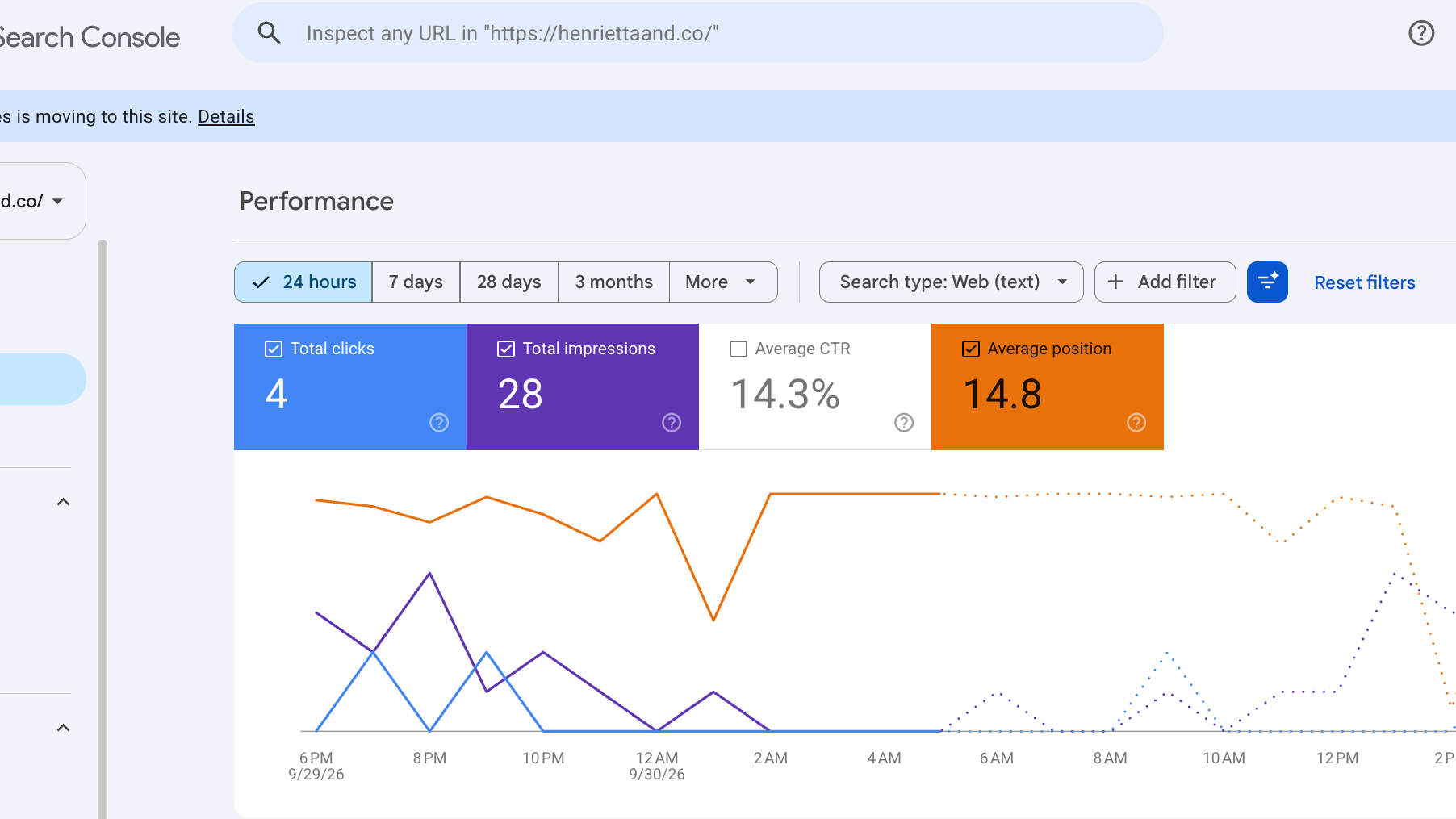
Within 24 hours of the switchover, henriettaand.co was appearing in Google results, including position 1 for "bath wedding bands". That is an early signal, not a result. The rankings that matter are measured over months, and Google's real-user speed data for a new domain usually appears after about 4 weeks.
The first review is at 4 weeks and the second at 12, both measured against the pre-launch baseline. Success means the product rankings hold while traffic from the old name falls no faster than the forecast. This post will be updated with those numbers.


